
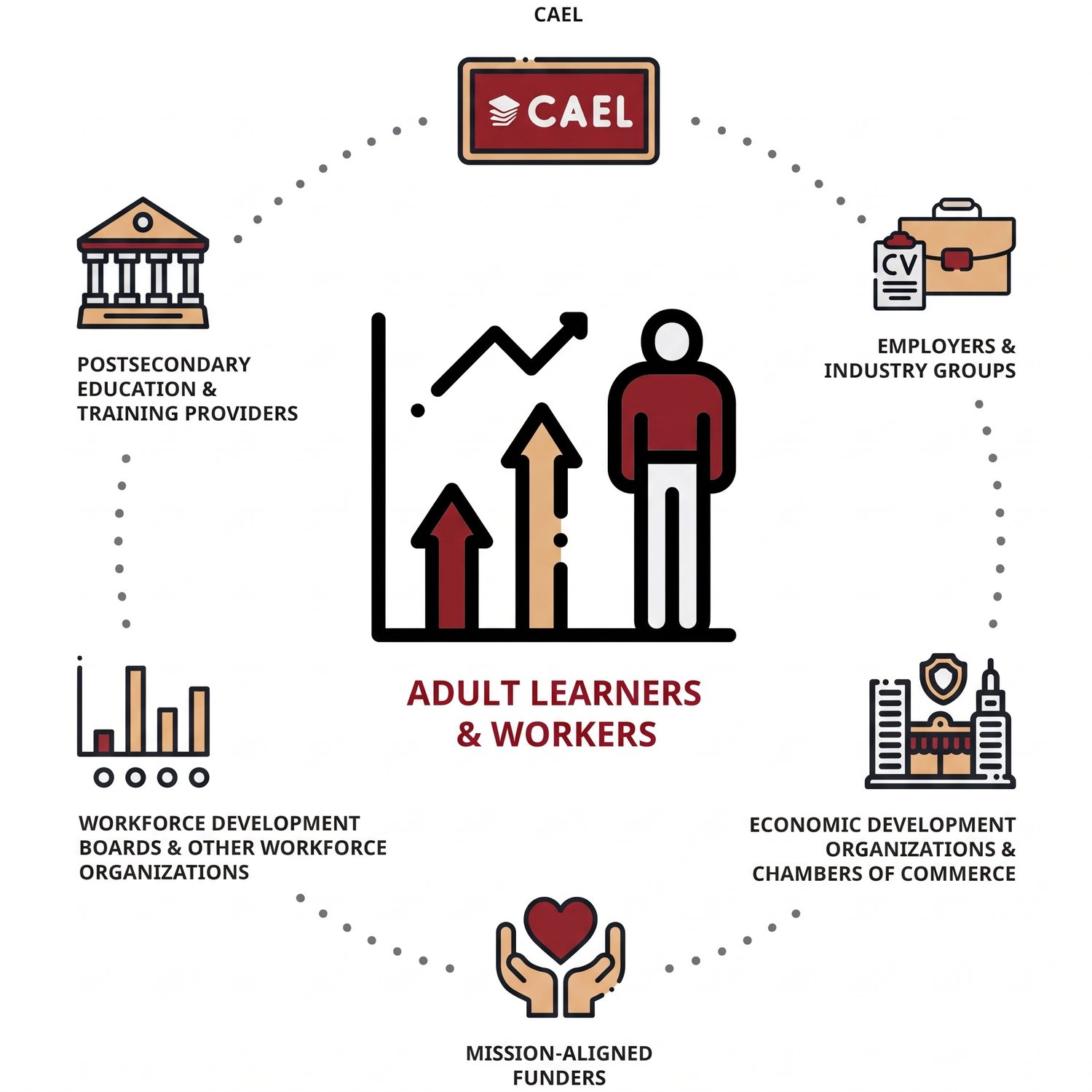
When these sectors work in silos, adult learners hit dead ends. When they work in concert, learners move through cycles of skill building and employment toward economic mobility, and the ecosystem delivers far more impact than separate efforts could.
CAEL connects each part of the ecosystem, collaborating across sectors so experience counts, learning leads to opportunity, and adult learners can move toward economic mobility in the communities where they live, learn, and work. Here’s how we can partner with you:
Postsecondary Education and Training Providers
- Enable institutions to award credit for prior learning through tools like Credit Predictor Pro.
- Assess your institution’s effectiveness in serving adult and working learners, and chart a clear, measurable path forward with the Adult Learner 360TM diagnostic.
- Connect institutions with employers and workforce organizations to ensure curricula aligns with industry needs and strong education-to-employment pathways.
- Build a shared pathway model, so learner progress carries across systems instead of stopping at institutional boundaries.

Workforce Development Organizations
- Connect adult and working learners to postsecondary credentials and careers that move them off public assistance and onto a path toward economic mobility.
- Align community partners and resources to enable measurable regional growth and prosperity.
- Strengthen your region’s appeal to prospective employers with talent pipelines built around industry hiring needs.
- Implement tested models from other regions, ensuring partnerships with community institutions, training providers, and employers compound for your clients.

Economic Development Organizations
- Promote economic mobility by connecting adult learners in your community to education-to-career pathways that lead to better jobs.
- Align postsecondary institutions and training providers, employers, and workforce organizations around shared regional goals and strategy.
- Leverage data gathering capabilities to set regional goals, shape strategy, and track whether adult learners are moving toward economic mobility.
- Recognize on-the-job and other non-institutional learning through credit for prior learning and incorporation of stackable credentials.

Employers & Industry Groups
- Shape credentials and training around the skills your business needs, and co-design talent pipelines with postsecondary partners so training fits your hiring needs and the flow of work.
- Strengthen your education benefits and learning and development strategy to help employees upskill, explore careers, and keep growing with your business.
- Help workers affected by layoffs or restructuring move into new roles with occupational crosswalks, pathways, and skills transfer support.
- See it in action: Industry coalitions like EPCE and NACTEL connect employers to a curated consortium of high-quality training providers.

Chambers of Commerce
- Connect chamber members to talent and training partners through networking events and professional development opportunities built around their needs.
- Bring workforce development boards, economic developers, industry and employers, and postsecondary institutions to the table around shared regional goals.
- Align learning providers, employers, and workforce organizations so adult learners in your community move into better jobs and greater economic mobility.
- Leverage labor market reports to see where regional hiring needs are growing and point training toward them.