
Share this
by CAEL on Feb 12, 2026
A return to our Roots: CAEL resumes independent status
At our 51st annual conference, CAEL President Earl Buford shared a milestone moment: CAEL is officially operating as an independent nonprofit organization once again. After a productive seven-year alignment with the Strada Education network—a period that saw our membership triple and our impact double—we are returning to the independent 501(c)(3) status that defined our first 44 years. This transition allows us to lean into our mission with renewed agility as we continue to scale work-and-learn pathways across the nation.
As we move forward independently, we are guided by a clear vision: aligning learning and work in ways that drive economic mobility and broaden access to opportunity.
— Earl Buford, President/CEO
Scaling impact through regional frameworks
CAEL is evolving from individual interventions to systemic solutions. We are proud to introduce the MyCareerForward Initiative, currently piloting in Pittsburgh, with support from national and locally based philanthropy.
- Growing Industries with talent needs.
- Higher Education institutions.
- Local Workforce Training providers.
This initiative acts as a regional bridge between:
By aligning these stakeholders, we ensure that "all learning counts," turning the "national skills currency" into a reality for adult learners.
CAEL has long advocated for regional-based approaches to meeting systemic challenges in educational attainment and workforce development. Individual adult learner/worker success, economic mobility, and even broader community prosperity all depend on flexible systems of opportunity in which the many moving parts across our industry-education-workforce ecosystem can act more cohesively and effectively, leaving nobody behind.
Qualified workers are often overlooked when we discount the competencies they’ve gained through various learning experiences and fail to connect their prior learning to new pathways. Fortunately, there is growing policy and political will for linking learning and work. One of the latest examples is the CTO Challenge, a federal funding effort to embrace a “national skills currency.” This evolving landscape is creating fertile ground for CAEL to scale our longstanding mission to drive economic mobility by ensuring that all learning counts.
Over the past several years, CAEL has been developing a structured approach to understanding the dynamics of a region and implementing strategies that deliver measurable impact for individuals and communities. We are aligning stakeholders to replace either/or dilemmas with both/and solutions that set individuals up for success. CAEL is applying the lessons it has learned as a trusted national intermediary to create the MyCareerForward Initiative, a regional approach to connecting growing industries, talent diversity goals, local workforce training, and higher education so that all workers have more clearly defined, digestible, and supported pathways into the high-wage occupations that drive equitable economic growth. You can read more about MyCareerForward, which we are piloting in Pittsburgh, here.
In today’s interconnected world, strong regional ecosystems play a critical role in driving innovation, economic mobility, and community prosperity.
Partner with us: Contact Dr. Beth Doyle at bdoyle@cael.org to discuss CTO Challenge grants or regional initiatives.
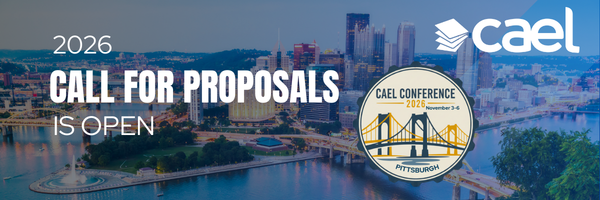
2026 Annual Conference: Call for proposals
- 2026 Conference Location: Pittsburgh, Pa. | Dates: Nov 3-6
- Call for Proposals Deadline: March 31, 2026
CAEL is now accepting proposals from individuals, institutions, employers, and workforce development entities interested in presenting at our annual conference in Pittsburgh, Nov 3-6.
Thanks to our hybrid conference format, your audience will be a diverse mix of fellow thought leaders and practitioners representing the education-employment ecosystem both in person and virtually. Our attendees represent workforce and economic developers; chambers of commerce; postsecondary educators; training organizations, employers and industry groups; foundations, and many other mission-aligned organizations.
All session proposals must be submitted by March 31, 2026. We will notify selected presenters in July. Click Here to begin the process. Sponsorship opportunities are also available.
CAEL virtual convening to be held April 21-22
On April 21-22, CAEL will host Connecting the Dots: The Education and Employment Loop, a virtual convening. Keynote speaker Paul Fain’s presentation, fittingly titled “Blurring Lines Between Education and Work,” will showcase the perspective of a seasoned higher ed reporter on the effectiveness of programs designed for adult learners and how AI is impacting their ability to secure quality jobs. The convening will also focus on perennial challenges like enrollment and retention, the ROI of a credential, work-based learning, workforce Pell, and much more. CAEL member discounts and sponsorship opportunities are available. We hope to see you there!
The "golden rule" for credit mobility
CAEL’s Credit Mobility Working Group recently released a white paper advocating for a learner-centered approach to transfer credits. The Golden Rule: Institutions should proactively provide the same level of documentation detail for Credit for Prior Learning (CPL) that they would expect when evaluating incoming transfer credits.
In October, CAEL partnered with AACRAO and Sova to host Transfer Myth-Busting! Making the Case for Credit Mobility. During the webinar, held within National Student Transfer Week, experts challenged the misconceptions of credit mobility, advocating for a more learner-centered approach for transfer students. In making the case for credit mobility and CPL, they included data and perspectives from national, institutional, and learner perspectives. Presenters included Juana Sanchez, project director, SOVA/Beyond Transfer Initiative; Dr. Wendy Kilgore, senior director of research, AACRAO; Dr. Beth Doyle, chief of higher education strategy and impact, CAEL; Rose Rojas, director, Center for Curriculum and Transfer Articulation; and Dr. Tony Sheppard, professor emeritus, California State University.
Shortly after, CAEL’s Credit Mobility Working Group released a white paper urging the adoption of a “golden rule” for tackling the complex and often technical issues of CPL mobility. This approach would address the lack of data standardization and documentation that results in a lack of understanding of what to look for among receiving institutions. The golden rule mindset calls for institutions to proactively provide the same level of detail in their documentation of CPL that they would expect when evaluating incoming transfer CPL. The white paper also includes case studies detailing real-world approaches to the challenges and opportunities of CPL in transfer.
Success spotlight: Barry University
Using CAEL’s Adult Learner 360™ diagnostic tool, Barry University confirmed their students’ high satisfaction levels, scoring well above the national median. This data-driven approach allows institutions to align their services with CAEL’s 10 Principles for Effectively Serving Adults.
Adult learners attending CAEL institutional member Barry University have given the university high marks, the university detailed in a recent blog post. The student feedback was captured this fall via the university’s participation in CAEL’s Adult Learner 360. As noted in its article, Barry University consistently scored above the median, indicating that its adult learners have reported very high satisfaction compared to peer institutions.
Institutions receive results in the forms of raw and comparison data, a gap analysis, and an assessment relative to national median scores. CAEL experts also provide a comprehensive written analysis that includes specific recommendations aligned with CAEL’s legacy 10 Principles for Effectively Serving Adults and the Framework for Creating Adult Learner Leaders for Institutional Effectiveness (ALLIES).
Takeaways from CAEL’s lead role in career-exploration platform pilot
In 2021, CAEL was awarded a U.S. Department of Education Grant to lead the development of a personalized digital career-exploration platform. CAEL piloted the three-year project in six regions: Prince George's County, Maryland; Central Indiana; Rhode Island; Racine, Wisconsin; Maricopa County, Arizona; and southwestern Ohio. Regional partners, with the support of national partners, tested the platform, known as Exponential Pathways, or XP, exploring different approaches to helping high school students and other young adults make informed decisions about navigating complex educational and career options.
Their input not only guided the platform's development but contributed to valuable insight about the intersection of emerging technology and time-tested principles. By assessing the differences and similarities among the regional pilot experiences, CAEL identified recommendations that would help high schools, nonprofit organizations, local governments, and other stakeholders undertake similar efforts with greater efficiency. Read more.
LEARN commission final report calls for less bias, more data when evaluating prior learning
The Learning Evaluation and Recognition for the Next Generation (LEARN) Commission has released its final report. Learning Evaluation for the 21st Century: Recommendations To Transform Policy and Practice To Meet Changing Needs urges higher ed practitioners to avoid a deficit-based mindset by embracing diverse learning experiences that should count toward credit for students pursuing further education. Dr. Beth Doyle, chief of higher education strategy and impact at CAEL, is among the LEARN commissioners.
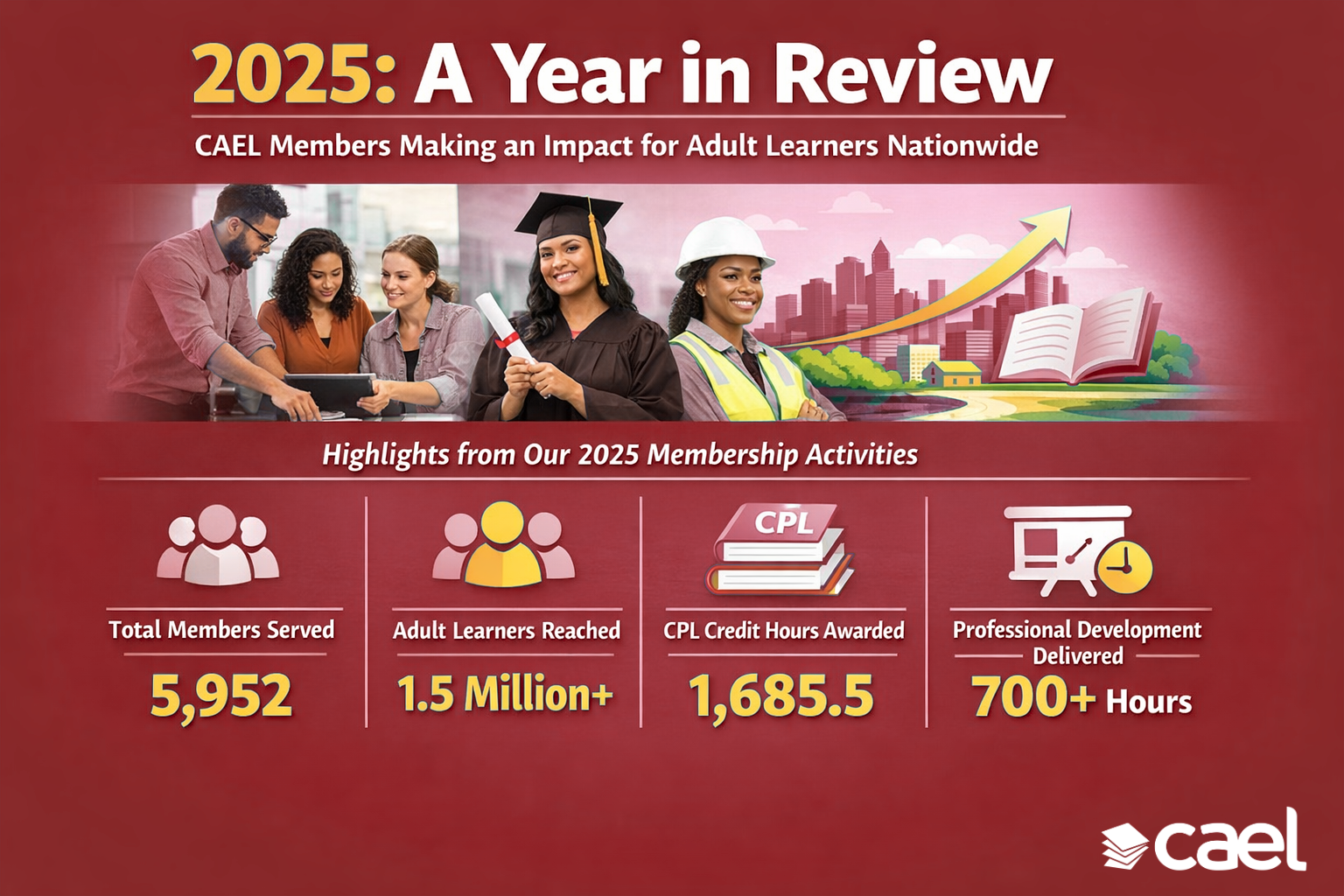
2025: A year in Review
CAEL members are actively pursuing ways to dismantle barriers, identify opportunities, and establish partnerships so that adult learners can navigate lifelong learning and career pathways. We are honored to include such passionate advocates and champions among our diverse member community.
Here are just a few highlights from CAEL’s 2025 membership activities:
Professional Development
New Cohorts Start Feb. 23!
Strengthen your institution's capacity with our upcoming instructor-led courses:
Registration is open for the next cohorts of CAEL’s professional development opportunities. Courses begin Feb. 23 for the following online programs:
From the Ground Up: Building the Foundations of a CPL Program
The Workforce Ecosystem: Building Partnerships for Community Growth
The Data-Driven Approach to Recruiting Adult Learners
Member and group discounts apply to all courses.
In addition to the above instructor-led training, CAEL offers eight microcourses that are open to all members. Follow CAEL’s professional development and training page or sign up to receive future announcements.