
Share this
by Carlo Bertolini on Jul 13, 2026
Registrars are seen as gatekeepers of academic integrity. Proponents of credit for prior learning (CPL) are seen as reducing barriers to credential completion. Viewed apart, these efforts may appear contradictory. But April Shirey, registrar of Muskegon Community College (a CAEL institutional member), sees the big picture, and it's one that has room for the best of both worlds.
"Embracing CPL is about removing unnecessary barriers for students, and as registrars, we can also protect academic integrity in this process," said Shirey, who joined MCC in December of last year. "I see CPL as a critical strategy for aligning institutional policy with the realities of today's learners. CPL allows us to recognize validated learning wherever it occurs, reduce unnecessary barriers to completion, and ensure our systems are both equitable and responsive, particularly for adult learners."
| Read more: | CAEL, American Association of Collegiate Registrars and Admissions Officers partner to boost CPL |
For Shirey, CPL has a major role to play in those improvements. "CPL benefits both students and the institution," she said. "By recognizing valid, college-level learning acquired through professional experience, military service, or prior training, institutions reduce unnecessary course repetition while maintaining academic standards. Students who receive appropriate CPL are more likely to persist, enroll in additional coursework, and complete their academic programs. Ultimately, when awarded responsibly, CPL strengthens institutional effectiveness by supporting student completion, optimizing instructional resources, and aligning credit with demonstrated competency, benefiting faculty, students, and the college as a whole."
In fact, CAEL research has shown that receiving credit for prior learning (CPL) boosts completion rates among adult learners by 17%. CPL also saves students significant time and money. To Shirey's point about CPL's positive-sum benefits, because CPL students persist and complete at greater rates, they also complete more traditional credit hours. CPL can also offer recruiting impact: Additional CAEL research has found that the vast majority (84%) of likely enrollees said the ability to receive CPL would significantly influence their choice of institution.
| Read more: | The recruiting potential of CPL |
Parallel surveys confirm CPL’s potential
CPL was among the highlights of MCC's recent participation in Adult Learner 360TM, CAEL's integrated diagnostic tool. Adult Learner 360 is informed by layers of complementary data derived from decades of aggregated CAEL research and surveys of faculty, staff, and adult learners completed during each iteration with participating institutions. It assesses the performance of key adult learner success factors such as career pathway access, credit for prior learning, and student support services. By employing parallel surveys that capture institutional and adult learner perspectives, Adult Learner 360 translates feedback into opportunities for meaningful improvement, revealing where critical perspectives align and diverge. Survey analysis includes comparisons to national median student satisfaction scores.
Results from Adult Learner 360 surveys are measured through the lens of CAEL's research-based Adult Learner Leaders for Institutional Effectiveness (ALLIES) Framework. The framework offers guidance for meeting the diverse needs of adult learners amid ever-shifting education and employment landscapes. It applies an iterative, change management process for achieving adult learner success within a culture of continual improvement.
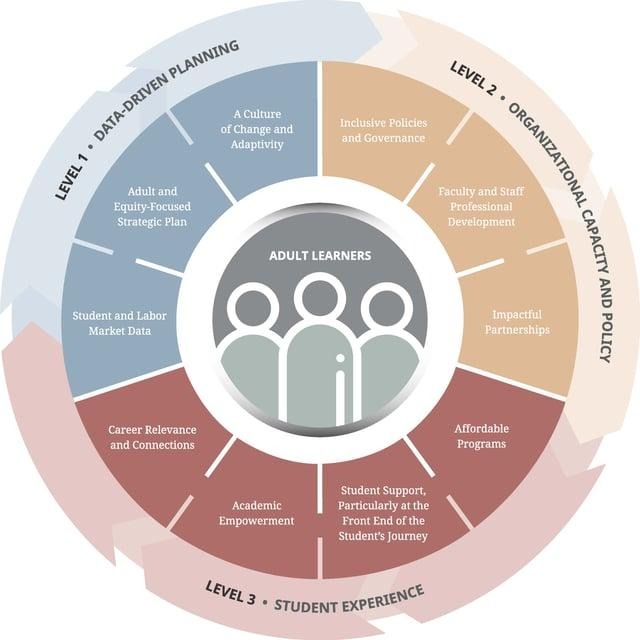
MCC received access to Adult Learner 360 through its participation in the Michigan Learning Evolution and Academic Restructuring Network (MI-LEARN) Design Lab, a Michigan Center for Adult College Success (MCACS) initiative that partnered with CAEL and other organizations to help postsecondary institutions enhance adult learner success.
Scaling CPL and its power to link learning and work
The report validated what MCC already knew: that CPL was an area of opportunity for bolstering support for adult learners. But it added data and external perspective needed to elevate the conversation and build broader institutional support, said Shirey. "It helped move CPL from an operational insight to a priority."
"Adult Learner 360 mattered because it allowed us to move beyond anecdotal feedback and see systemic patterns," she said. "It also supported our broader efforts around CPL, transfer mobility, and adult reengagement, all part of our strategic priorities for the college. For us it was equally important to gather multiple perspectives that helped us identify those systemic barriers and misalignments that adult learners experience holistically. This positions us as a college to coordinate institution-wide improvements instead of just isolated, Band-Aid fixes."
For example, MCC's Adult Learner 360 analysis highlighted opportunities to dovetail two focus areas, CPL and career services, boosting the impact of each on student success and institutional growth. The approach leverages CPL as an organic link between classroom and career progression.
"From a registrar's perspective, CPL can absolutely serve as a natural bridge to career services," said Shirey. "It recognizes learning through work and life experiences, the same experiences career services helps students translate into career advancement. When students see their work experience reflected on an official transcript, it validates that their prior learning has real academic value. It shifts the college career pathway from something separate to something connected where their experience counts toward their goals. For adult learners especially, this can build confidence, increase engagement, and make the path to completion feel more relevant and attainable."
"For adult learners, the CPL process can open the door to broader conversations about skills, goals, and career pathways," she added. "While that connection isn't always fully integrated yet, we see strong potential to better align CPL and career services to support both academic progression and career outcomes."
CPL in transfer
MCC's Adult Learner 360 results also noted the college's significant progress in solving complex transcripting issues, underscoring the benefits of marshaling registrars as strategic partners in CPL and, more broadly, student recruitment and retention. "At MCC, our plan is to be intentional about how we code CPL to ensure both transparency and transferability," said Shirey. "Whenever possible, we transcript CPL as equivalent coursework aligned to specific course outcomes, rather than as general CPL credit."
This contrasts with how nontraditional credits were previously grouped as lump sums at the top of the transcript, Shirey said. Today, the college has developed a solution for displaying these as specific course equivalencies within its student information system, incorporating a notation indicating the credit type. "The next step is to move through the approval process and implement it."
MCC is also in discussions with transfer partners to ensure they will accept credits presented in that format. "We recognize that transfer acceptance of CPL can vary by institution, particularly depending on how credit is coded," said Shirey. "While we have not fully resolved these challenges, we are actively working with key transfer partners to better understand their expectations and refine our approach."
The collaborative approach has helped MCC in refining its own processes, she said. "We've been influenced by both national examples and regional partnerships. Davenport University and Shasta Community College have provided helpful models for thinking about how CPL can be applied and scaled, while our ongoing conversations with Grand Valley State University around transcripting have been especially valuable in shaping how we approach transfer. Across all these relationships, what stands out is the openness to share practices and work through challenges together."
| Read more: | CAEL working group coins ‘golden rule’ for CPL mobility |
As for what she would tell registrars at other institutions who may be hesitant about CPL, Shirey said, "When done well, CPL is not about lowering standards, but about evaluating learning through clearly defined outcomes, faculty-informed processes, and documented evidence. Our role helps ensure that CPL is rigorous, transparent, and accurately reflected on the transcript. While there are still challenges, particularly around transferability, those are reasons to stay engaged in the work and not avoid it."