
Share this
by Guest Blog on May 27, 2026
Instructional Innovation: AI + Modular Learning To Improve Completion Rates
By Fahim F. Karim
Manager of economic stability and mobility at Employ DMV

This blog is part three of Fahim F. Karim’s series on systems-level Workforce Pell readiness.
|
|
Read more: |
Workforce Pell Is Coming—Are Our Systems Designed for Completion and Employment? |
|
Who Fits Where? Credit for Prior Learning, Intermediaries, and the Workforce Pell Ecosystem |
Persistence—the ability of learners to continue and complete a program—is often a stronger predictor of long-term success than initial enrollment. Yet across U.S. postsecondary education, persistence and completion remain stubbornly uneven, particularly for adult learners, part-time students, and learners navigating work, caregiving, or reentry responsibilities.
According to recent data from the National Student Clearinghouse Research Center, the national six-year completion rate across two-year and four-year institutions has plateaued at approximately 61 percent. This trend suggests that most institutions could struggle to meet Workforce Pell’s 70 percent completion requirement without meaningful redesign.
This challenge becomes even clearer when viewed through institutional selectivity. Highly selective institutions—those admitting fewer than 25 percent of applicants—achieve completion rates near 89 percent, while open-admissions institutions average closer to 29 percent.
Six-Year Completion Rates by Institutional Selectivity Range (4-Year Institutions)
|
Acceptance Rate Range |
Completion Rate (within six years) |
|
Most Selective (< 25% accepted) |
89% |
|
Highly Selective (25% to 49.9% accepted) |
73% |
|
Moderate Selectivity (50% to 74.9% accepted) |
61% |
|
Broad Selectivity (75% to 89.9% accepted) |
54% |
|
Least Selective / Open Admissions |
29% |
Enrollment patterns further underscore this tension. Open-access institutions disproportionately serve the very learners Workforce Pell is intended to support—yet they face the steepest structural barriers to meeting eligibility thresholds. Based on federal data and enrollment trends, the total enrollment can be segmented by institutional selectivity as follows:
Estimated 2025 Enrollment by Acceptance Rate Range
|
Selectivity Range |
Enrollment Share (Approx.) |
Estimated Total Students |
|
Most Selective (< 25% accepted) |
~4% - 6% |
0.8 to 1.2 million |
|
Highly Selective (25% - 49.9% accepted) |
~10% - 15% |
2.0 to 2.9 million |
|
Moderate Selectivity (50% - 74.9% accepted) |
~35% - 40% |
6.8 to 7.8 million |
|
Broad Selectivity (75% - 89.9% accepted) |
~25% - 30% |
4.9 to 5.9 million |
|
Least Selective / Open Admissions |
~15% - 20% |
2.9 to 3.9 million |
As you can see in the chart above, the most selective institutions educate a relatively small share of students, while the majority—an estimated 14.6 to 17.6 million learners—are enrolled in moderately selective, broadly selective, or open-admissions institutions. As higher ed institutions seek to participate in Workforce Pell programs, they will need new instructional approaches to avoid unintentionally excluding candidates for Workforce Pell–eligible pathways—not due to lack of learner motivation or ability, but because existing program designs were never optimized for their realities.
This is where instructional design becomes a critical system lever.
When Mastery — not Seat Time — Drives Outcomes.
Organizations such as Cyber Ready Academy, offered through Cyber Ready Professional, a program designed to prepare IT and cybersecurity students for the workforce, have demonstrated what is possible when mastery—not seat time—drives instruction within a higher education–led credentialing model. In this case, Cyber Ready Professional partnered with Harford Community College. Located in Maryland, the college served as the accredited institution of record.
Harford Community College:
- Enrolled the learners
- Maintained academic oversight and compliance
- Issued the certificates and credentials
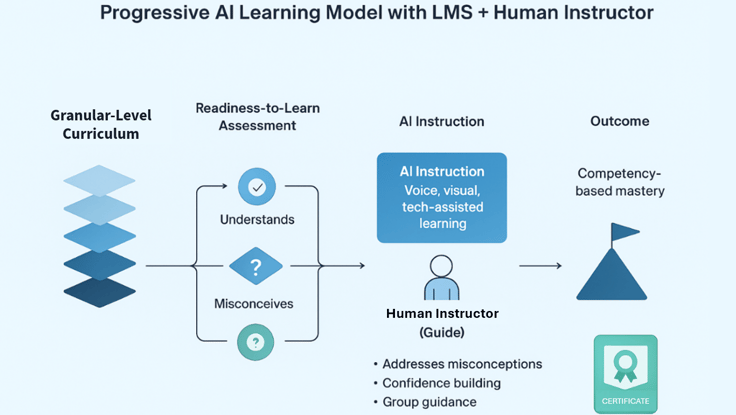
Cyber Ready Academy delivered instruction using an AI-based, progressive learning model, supported by an LMS (Learning Management System) and paired with targeted human instructor intervention. Students completing the course received a cyber security industry-recognized certificate. As a hybrid program, it allowed students to complete most of the course virtually while offering in-person attendance, all within a minimum clock-hour framework. Despite the course’s complex subject areas, this partnership model achieved 85 percent or higher completion and persistence rates.
Notably, the small share of learners who did not complete exited primarily due to life events, not out of dissatisfaction with the program. That distinction matters.
It suggests that when accredited institutions retain credential authority while partnering with providers who design learning around helping students overcome “unknown unknowns” to achieve mastery, instructional design ceases to be the limiting factor for completion.
In fact, according to Dr David Tobey, executive director of Cyber Ready Professional, the students don’t necessarily have to have an IT background to be successful in these types of courses. They also observed that in some instances, students who did not have an IT background performed better compared to the students who had.
From Employer Demand to AI-Based Instructional Design
Rather than beginning with existing courses, historical completion data, or legacy delivery models, institutions can start where Workforce Pell is ultimately anchored: employer demand.
A more strategic sequence looks like this:
- Which Workforce Pell–eligible roles are employers in our region actively hiring for?
- What skills and competencies do employers expect learners to demonstrate upon completion?
- How can those competencies be translated into granular-level curriculum components, designed from the ground up?
- Do we already offer credentials aligned to these skills—and if so, what do completion and employment outcomes reveal about our current instructional model?
When outcomes fall short, the question is no longer simply what is being taught—but how learning is structured, delivered, and supported.
This is where AI-based, progressive learning models—delivered through an LMS and paired with targeted human instructor intervention—represent a fundamentally different approach to teaching and learning.
In these models:
- Curricula are broken down to the modular level.
- Learners begin exactly where they are, rather than where the syllabus starts.
- Progression is mastery-based within a structured clock-hour framework—ensuring students meet the proposed clock hour minimum required for Workforce Pell while using AI to maximize the value of every minute spent in the program.
- AI identifies misunderstandings in real time and adapts instruction accordingly.
Critically, AI also identifies misconceptions that can arise when students have “blind spots” about obstacles preventing skill mastery. This allows human instructors to intervene precisely when such misconceptions persist, often working with small groups experiencing similar challenges.
Such misconceptions are a major issue. If not addressed early, they impact the student’s ability to successfully complete the course in later modules. Removing misconceptions requires an expert human instructor to intervene and assist to ensure students have a correct understanding.
The importance of this is captured in a saying attributed to the famous American writer and humorist Mark Twain (1835-1910), best known as the author of The Adventures of Huckleberry Finn and The Adventures of Tom Sawyer:
“It ain’t what you don’t know that gets you into trouble. It’s what you know for sure that just ain’t so."

For institutions, this introduces a pivotal design decision:
- Regulatory Alignment: How do we intentionally align mastery-based progression within clock-hour minimums required for Workforce Pell eligibility?
- Internal capacity: Do we have the bandwidth to design and deliver AI-enabled, mastery-based instruction at this level of precision?
- Strategic partnerships: If not, whom can we partner with that already operates these models at scale—while the institution remains the accredited provider issuing the credential—and how do we structure these arrangements to remain within the final rule’s 25% third-party instructional cap (increased to up to 49% if tied to a Registered Apprenticeship)?
Note on Federal Eligibility: While these models prioritize mastery, institutions pursuing Workforce Pell funding must ensure their AI-enabled curricula are mapped to a minimum of 150 to 599 clock hours (or equivalent credits). Pure "Direct Assessment" programs that lack a fixed time-based component remain ineligible under Workforce Pell's finalized federal guardrails.
The Role of Intermediaries and Workforce Partners
Critically, instructional redesign cannot happen in isolation.
Intermediaries such as CAEL, along with state and local workforce development boards, play a vital upstream role—helping institutions identify:
- In-demand occupations within their region
- Employer-validated skills and competencies
- Existing career pathway frameworks that inform curriculum design
CAEL’s career pathway maps, developed in partnership with employers and workforce boards across the country, provide institutions with a strong starting point for aligning instructional design to labor market demand—rather than designing credentials in a silo.
When higher education institutions collaborate with intermediaries, workforce partners, and employers, they gain a clearer line of sight from skill → curriculum → mastery → credential → employment.
| Read more: | Career Pathways Maps and Virtual Mentors Help Adult Learners Chart Their Success in South Central Pennsylvania’s IT Sector |
Key Reflection Question
For high-demand, employer-driven credentials with low completion rates today, how might outcomes change if instruction were redesigned using an AI-based, progressive, mastery-driven learning model, supported by targeted human instruction and informed by employer-validated skills identified through intermediaries and workforce partners?
Looking Ahead
If Workforce Pell challenges systems to rethink alignment, partnerships, and credential design, it also raises an equally important question about how credentials connect over time.
In the next post, I plan to explore how stackable credentials and pathway design—built from completion backward—can support learner momentum, employer confidence, and long-term mobility, especially in Workforce Pell–eligible programs.
Fahim F. Karim is the manager of economic stability and mobility at Employ DMV (a regional ecosystem), advancing education-to-employment systems across the DC, Maryland, and Northern Virginia region. A Maryland Workforce Association award recipient, Fahim integrates strategy, operations, and partnerships within his work to reduce opportunity-limiting barriers and strengthen workforce outcomes and economic mobility.