
Share this
by Guest Blog on Mar 04, 2026
By Fahim F. Karim
Manager of economic stability and mobility at Employ DMV

In the first post of this series, I introduced a learner-centered Workforce Pell ecosystem—one that places the learner at the intersection of higher education, workforce development, employers, policy, and support systems. That framing surfaced an important systems-level reality: no single institution or sector delivers completion and employment outcomes alone.
As organizations begin to visualize Workforce Pell implementation through this ecosystem lens, a natural set of questions tends to emerge. If accredited institutions sit at the center of Pell eligibility, where do high-quality training providers outside of higher education fit? How do intermediaries support alignment without duplicating effort? And how do systems translate existing skills, experience, and short-term training into credit-worthy, compliant pathways that accelerate—not delay—learner progress?
These questions are not about replacing higher education. They are about capacity, coordination, and design—especially in fast-moving industries where skills evolve more quickly than traditional academic cycles. They also point to the growing importance of intermediaries, credit for prior learning (CPL), and technology-enabled tools that help systems operate at scale while keeping the learner experience coherent.
To ground this next layer of the ecosystem, it helps to step back and visualize Workforce Pell implementation through a simple analogy—one that makes the roles, relationships, and handoffs between partners easier to see.
Workforce Pell as a Modern Transportation System:
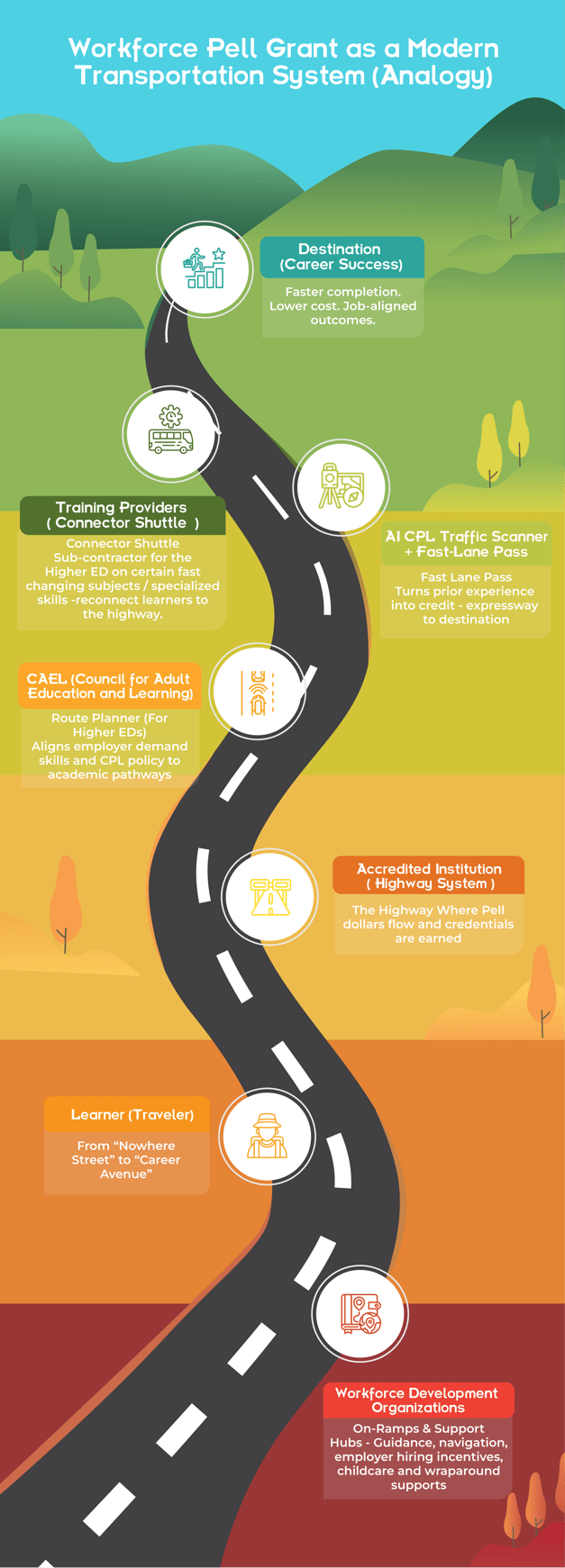
Think of Workforce Pell implementation as building a modern transportation network:
- Learner = Traveler
Trying to get from Nowhere Street → Career Avenue as efficiently as possible. - Accredited Institution = Highway System
This is the regulated, certified route where federal Pell dollars are allowed to flow. - CAEL = Route Planner and Road Surveyor
CAEL identifies which roads are worth building—aligned to where the jobs (destinations) actually are—by translating employer skill needs into academic pathways and CPL policy. - CPL Technology Solutions (e.g., CPL tools/methods (such as Credit Predictor Pro, including AI emerging models like KnowMeQ) = Traffic Scanner + Fast-Lane Pass
They scan a traveler’s prior experience and grant express access—skipping redundant coursework and shortening the journey. - Training Providers/Third Parties = Specialized Shuttle Services
For stretches of the journey the highway doesn’t cover (highly specialized or fast-changing skills), these providers deliver instruction and reconnect learners back to the accredited route, with every “mile” captured as official credit on the transcript. - Workforce Development Organizations = Travel Guides and Support Hubs
They help with navigation (Career Coaching and Career Matching and connecting to the correct Higher Ed partner for the relevant Workforce Pell Grant Certification), also offer lodging (wraparound supports such as child care, transportation etc.), and local advisories (bringing in other Workforce Development Board partners to address other barriers to completion, such as mental health support). - Destination = Career Success
Faster completion, lower costs, and stronger employment outcomes.
With that frame in mind, here’s how my ecosystem map—and organizations like CAEL and KnowMeQ—fit together. I have also attached a diagram to help visualize the future state.
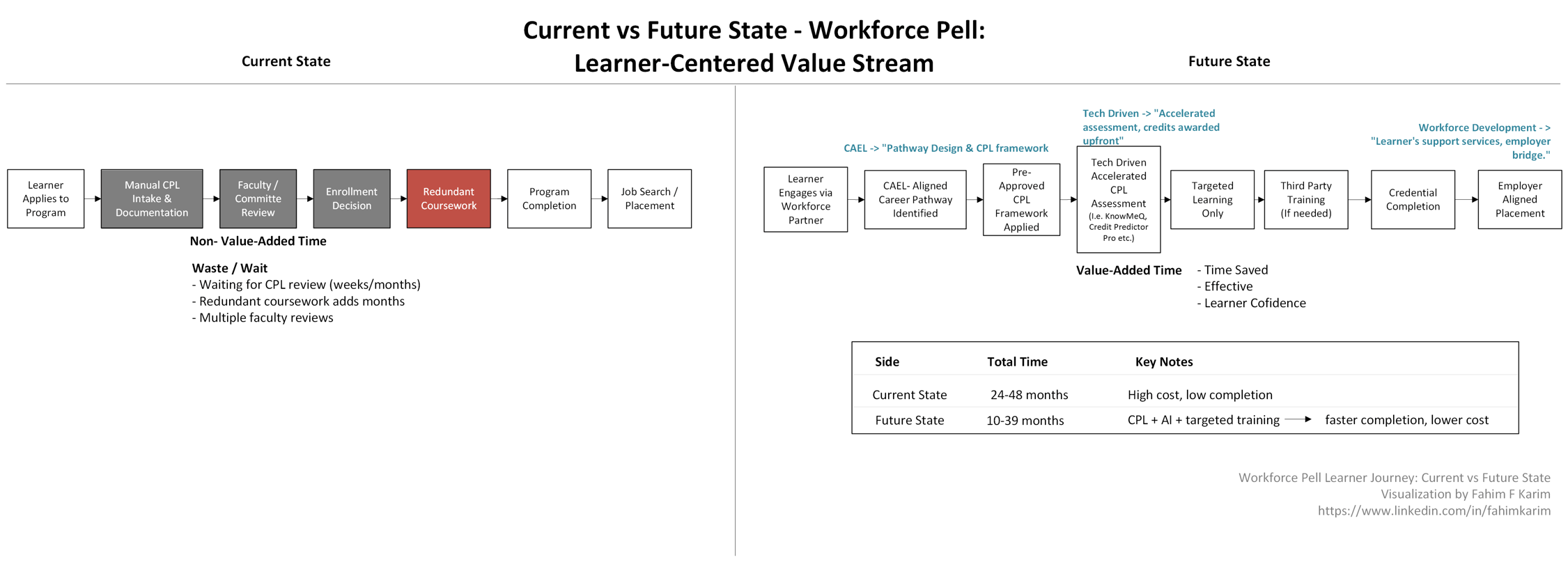
Click to enlarge
Where Training Providers Outside Higher Ed Fit:
In many technical and fast-evolving industries, universities don’t always have the most current tools or delivery capacity. Specialized providers often:
- Hold strong labor-market credibility.
- Teach employer-validated, up-to-date skills.
- Offer industry-recognized certifications.
In this model, they don’t replace higher ed. Instead, they expand capacity while the accredited institution (higher ed) retains enrollment, academic oversight, and transcript authority.
CAEL plays a critical intermediary role here by:
- Identifying in-demand pathways with employers.
- Mapping competencies to academic outcomes.
- Designing CPL frameworks that make prior learning credit-worthy.
Once those rules are established, CPL technology solutions like those I mentioned above allow institutions to implement CPL at scale—giving learners early clarity and reducing administrative backlogs.
A Key Accreditation Clarification (Often Missed)
A crucial point that often gets misunderstood:
It is not the course that must be accredited—it is the institution.
For Pell Grant eligibility:
- The institution must be Title IV-eligible and accredited by a federally recognized accreditor.
- Programs do not require separate accreditation for Pell purposes.
- Third-party providers can deliver instruction, but:
- The accredited institution must enroll the learner and record the credit on the transcript.
This is why partnership-based delivery models are not only allowed—they’re already working.
Credit-Worthy but Non-Transferable Programs (Already in Use)
Below are real-world program types that institutions are successfully operating today. These programs are faculty-approved and credit-worthy, and may be designed with Workforce Pell alignment in mind — though final eligibility depends on institutional accreditation, Title IV requirements, program length, and other federal criteria, even when credit is not intended to transfer externally.
|
Program Type |
How It Works |
Workforce Pell Alignment |
|
Employer-Sponsored Upskilling Bootcamps |
Short-term, industry-led training delivered by employers or third-party providers; faculty review outcomes and award institutional credit via CPL |
Credit-worthy, faculty-approved, tied to employment outcomes |
|
Healthcare Micro-Credentials |
Hospitals or clinics partner with universities to deliver role-specific training; students earn institutional credit |
Meets credit standards; completion and employment tracked |
|
Apprenticeship + CPL Programs |
Employer-based learning assessed through faculty-reviewed CPL portfolios and applied toward certificates or degrees |
Completion and employment measured; credit stays local |
|
Community College Short-Term Certificates |
6 - 12 week programs aligned to high-demand jobs; competencies defined by faculty |
Credit-worthy, outcome-aligned; transfer optional |
|
Adult Learner Stackable Pathways |
Microcredentials stack into certificates or degrees at the same institution |
Fully credit-worthy; support adult learners into jobs |
The key takeaway: Workforce Pell emphasizes completion and employment, not universal transferability.
How CPL Accelerates Workforce Retraining:
I am going to use an example from the logistics industry:
CPL shortens the distance between “what I already know” and “what I need on paper.” For adult learners, that distance is often the biggest barrier.
A typical logistics professional may bring:
- 5–15 years of experience.
- Skills in operations, inventory, scheduling, compliance, supervision, and analytics.
Without CPL, much of that experience goes unrecognized—leading to 2–4 years of coursework and $12K–$40K in cost.
Research from CAEL and WICHE shows that adult learners who receive CPL are 17% more likely to complete their credential, with completion rates of 49% compared to 27% for those without CPL.
On average, learners save 9–14 months toward completion and $1,500–$10,200 in tuition costs — demonstrating how recognition of prior learning reduces both time and financial barriers.
| Read more: | CAEL research highlights CPL's boost to completion and other key indicators of student and institutional success |
Tech-driven CPL solutions don’t replace these proven outcomes — they have the potential to scale them by streamlining evaluation processes and reducing administrative friction.
This applies across:
- Degree completion.
- Short-term certificates.
- Career pivots into IT, data, or project management.
Tech-driven CPL matters because it replaces slow, paper-heavy processes with early, consistent, scalable decisions—especially critical for workforce boards, community colleges, and employer-partnered programs.
The System-Level Impact of Tech-Driven CPL Solutions
Learners: Lower cost, faster completion, reduced fear of returning to school.
- Institutions: Higher enrollment and completion without overwhelming faculty.
- Employers: Faster access to credentialed talent.
- Systems: More agile reskilling during labor shortages.
In short, intermediaries like CAEL don’t just support Workforce Pell programs—they make completion, employment, and compliance achievable at scale.
Some reflective questions to discuss with your cross-functional teams:
- Which processes slow the learner's progress?
- How can partnerships accelerate CPL while ensuring quality/internal standards?
With compliant partnerships, scalable CPL, and ecosystem alignment in place, many systems will find that the next set of challenges doesn’t show up in policy or structure.
It shows up in how learning is experienced.
Workforce Pell doesn’t just expand access—it subtly raises expectations around persistence, progression, and completion. Meeting those expectations will require more than eligible pathways and well-designed partnerships. It will require a closer look at how instruction is designed, delivered, and supported as programs scale.
That’s where this conversation naturally leads next.
In the next blog post, I’ll turn attention to the instructional layer of the ecosystem—and why innovation in learning design may matter just as much as eligibility, compliance, and alignment.
Fahim F. Karim is the manager of economic stability and mobility at Employ DMV (a regional ecoystem), advancing education-to-employment systems across the DC, Maryland, and Northern Virginia region. A Maryland Workforce Association award recipient, Fahim integrates strategy, operations, and partnerships within his work to reduce opportunity-limiting barriers and strengthen workforce outcomes and economic mobility.